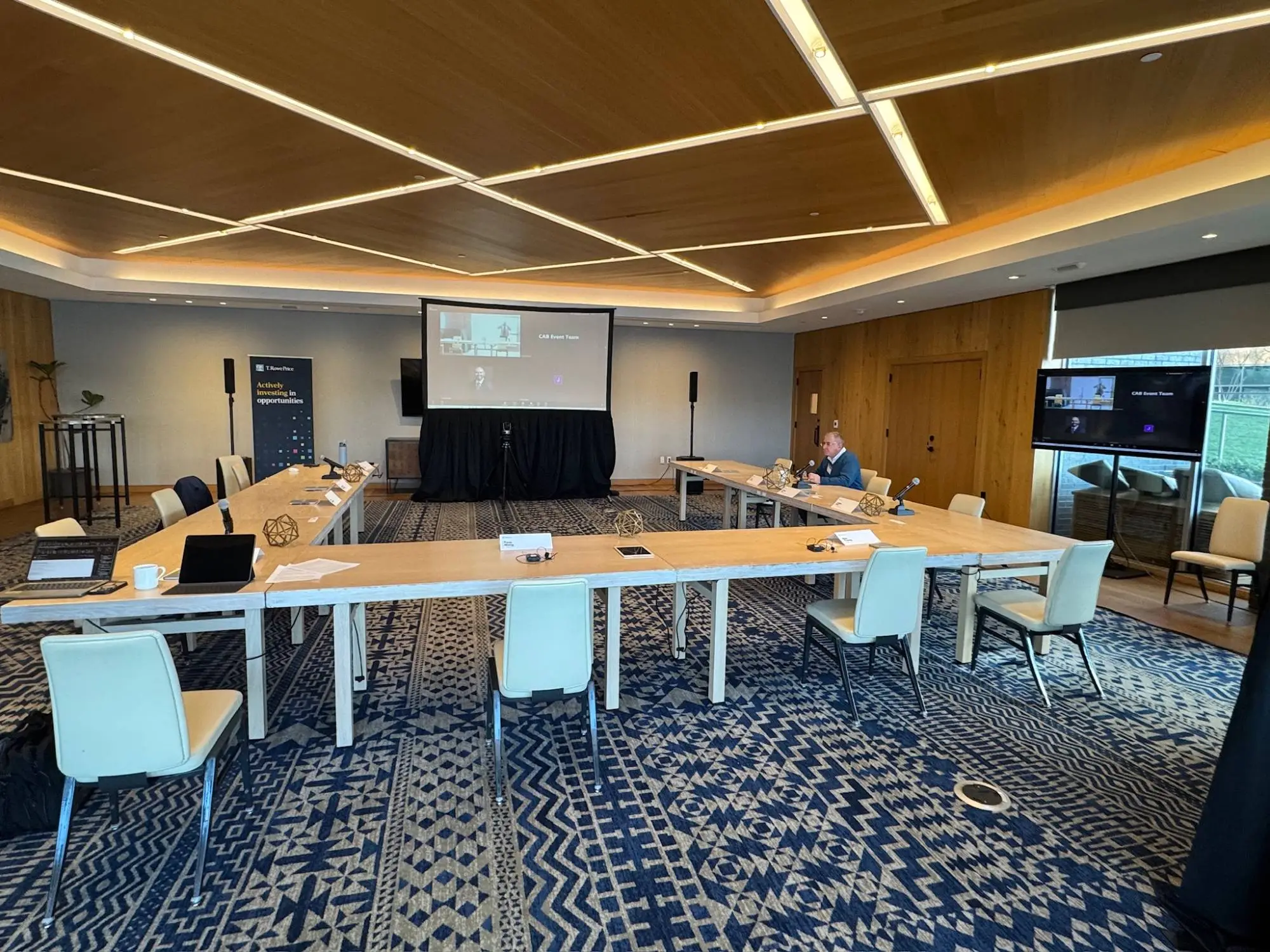
Corporate event AV in Baltimore is mostly about protecting one hour: the hour your leadership is on stage in front of the whole company. Our job is making sure that hour runs without a technical footnote: clear audio, slides that behave, a stream that holds, and an engineer in the room who has already rehearsed the failure modes.
What goes wrong at corporate meetings
The failures are predictable, which is why they’re preventable. The CEO walks away from the podium microphone and disappears acoustically. The presentation deck was built 16:9 but the screen isn’t, so the CFO’s numbers are cropped. A remote executive joins to present and the room hears them, but they can’t hear the room — or worse, they hear themselves back on a delay and stop mid-sentence. The house projector that “comes with the room” turns out to be dim, aimed badly, and owned by nobody in the building that day.
None of these are exotic. Every one of them is caught by an advance: checking content formats before show day, putting a lavalier on the executive who roams, engineering the remote path with a proper return feed, and never trusting a screen we haven’t tested.
What the AV plan should cover
- Program audio — a PA sized to the room, wireless microphones for every speaking role, and an engineer mixing live. See event audio.
- Presentation video — screens or an LED wall specced to the room’s light and sightlines, with a confidence monitor so presenters stop turning their backs to read slides. See video & LED.
- The remote audience — a produced feed with console audio and real camera shots instead of a webcam pointed at the stage. See hybrid & streaming.
- Presenter lighting — enough front light that faces read on camera and in the room, even when the ballroom look is dim.
- A run of show with an owner — someone accountable for transitions, timers, and the moment the Q&A microphone needs to be in row twelve.
Timeline expectations
Four to eight weeks out is a comfortable start for most corporate meetings, enough time to advance the venue, lock content formats, and schedule a rehearsal. We can move faster when we have to. The week of the event: content deadline, full system test before doors, and a presenter check for anyone who’ll hold a microphone.
What drives the budget
Room size and headcount set the scale of audio and video. The remote audience adds stream production and a dedicated engineer. Presenter count drives wireless channels. Rehearsal time adds crew hours but removes risk; it’s usually the best money in the budget. And the venue itself matters: rooms with good access and house rigging cost less to build in than rooms where everything enters through one freight elevator. We’ll walk you through the drivers on a call before any number lands on paper.