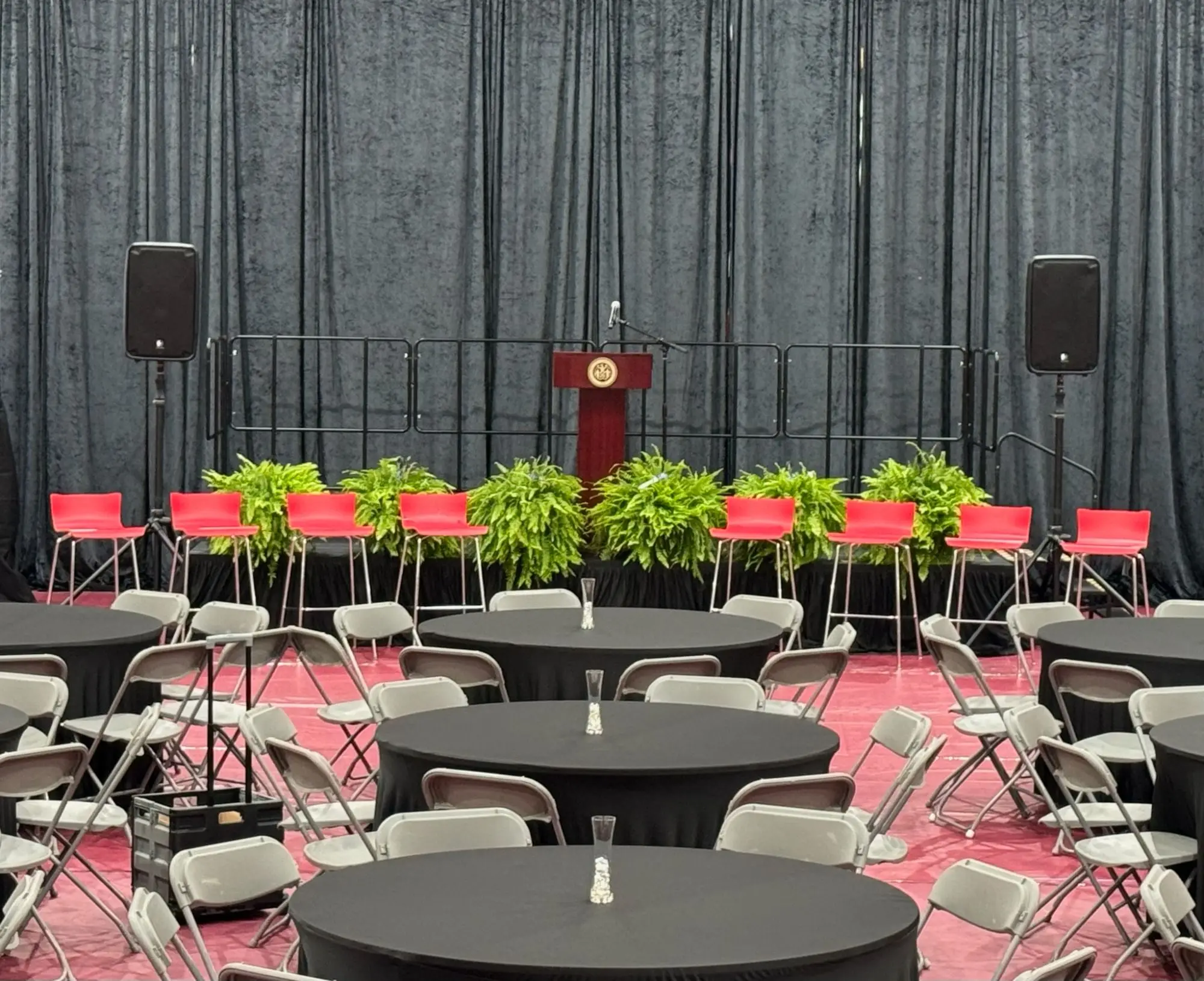
Two problems drive most stage rental searches in Baltimore: your venue’s stage is wrong for your program, or the room has no focal point at all. Staging solves both, but only when it’s engineered together with the audio, lighting, and video that live on and around it. We build staging and drape as part of the production, delivered and struck by the same crew that runs your show.
What this covers
- Stages and risers — modular decks at heights matched to the room and headcount, with steps, rails, ramps, and skirting included in the design rather than the fine print.
- Pipe and drape — clean runs to back a stage, divide a room, mask storage and service areas, or build entrances and reveal walls.
- Velvet drape walls — heavier, richer drape for galas and premium corporate events, where the wall itself is part of the room’s look.
- Scenic elements — stage facades, backdrop treatments, and branded set pieces coordinated with your lighting and video design.
- Camera and FOH risers — platforms for cameras and the mix position, placed where the crew can work without blocking the audience’s view.
What’s always included
Every staging job includes a floor-plan pass against the venue’s dimensions and fire lanes, delivery and build by our crew, decks leveled and rated for what’s on them, and a strike that leaves the room the way the venue expects. When lighting or an LED wall hangs above the deck, the staging and rigging plan is engineered as one structure, not two vendors pointing at each other.
How we spec it
The floor plan comes first. Stage size, drape runs, and riser placement get drawn against the actual room (doors, columns, chandeliers, fire lanes) before anything is quoted. A beautiful stage in the wrong quarter of the room fails as a design, and the venue walkthrough is where that gets caught.
Height is a sightline decision. A 16-inch stage disappears past the tenth row of seated guests; a 24- or 32-inch deck keeps a presenter visible to the back of a flat ballroom. We set deck height from your room depth and seating style, and we’ll show you the tradeoff against ceiling height and step count.
Drape is architecture. The question isn’t “do you want drape,” it’s “what should this room pretend to be?” A 200-person dinner in a 400-person room needs a wall that makes the smaller room feel intentional. That’s a drape plan: measured, weighted for the venue’s surfaces, and lit on purpose.
Load-in planning, floor protection, and how we handle venue rules are covered in our standards.