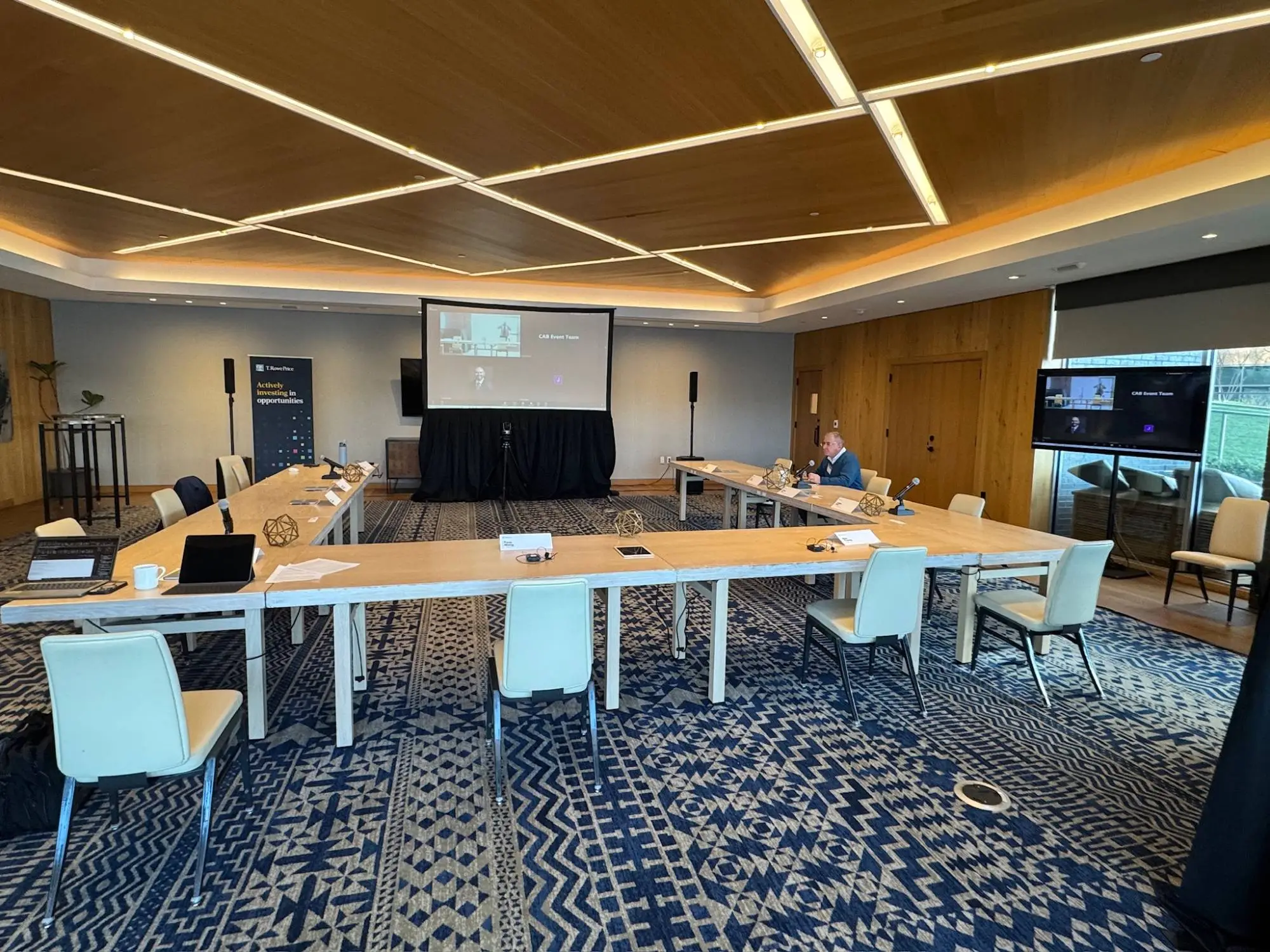
Live streaming a Baltimore event well means treating the remote audience as a second room — with its own audio mix, its own camera cuts, and its own engineer. That’s what we build: livestreams, webcasts, and hybrid meetings produced from your event, not pointed at it.
The gap between a stream people watch and a stream people abandon is almost always audio, which is why our streaming service is built on the audio-first approach described in our event audio work.
What this covers
- Livestreams and webcasts — keynotes, general sessions, and public programs streamed to YouTube, Vimeo, LinkedIn, Zoom, Teams, or your private platform.
- Hybrid town halls and meetings — in-room and remote participants in one program, with remote presenters mixed into the room and the room fed back to them cleanly.
- Multi-camera stream production — real camera angles, slides at native resolution, lower thirds, and a director cutting the program for the remote viewer.
- Press feeds and mult boxes — clean audio distribution for journalists and broadcast crews at press-facing events.
- Recording — program capture for archives, marketing, and on-demand publishing, recorded redundantly.
What’s always included
Every stream includes an engineer dedicated to the stream itself, rather than the room’s audio tech doing both jobs. It also includes a bandwidth check with your venue during the advance, a test of the full chain before doors, redundant recording, and a contact on headset who can tell you at any moment that the stream is healthy. Remote presenters get a tech check before show day, because their setup is now part of your show.
How we spec it
Audio comes off the console, never a room microphone. The remote audience hears the direct feed of every microphone in the program, mixed for headphones and laptop speakers, a different mix than the room’s. This one decision separates professional streams from webcam streams, and it’s non-negotiable in our designs.
The stream gets its own operator. During a live program, the room engineer’s attention belongs to the room. The stream’s levels, cuts, and platform health belong to someone whose only job is the viewer at home. One-person hybrid setups fail exactly when both audiences need attention at once, which at a live event is always.
Redundancy scales with the stakes. An internal all-hands can tolerate a hiccup; an investor call or a public press program cannot. For high-stakes streams we spec backup encoding and bonded-cellular internet standing by. We’ll flag which tier your event calls for and price both.
Connectivity standards, our camera workflow, and the backup policy live on the standards page.