Standards · 8 practices · every show
The standards behind every show we send
If you've bought AV before, this page is for you. These are the practices we hold on every production, written down so you can hold us to them too.
-
Consoles and control
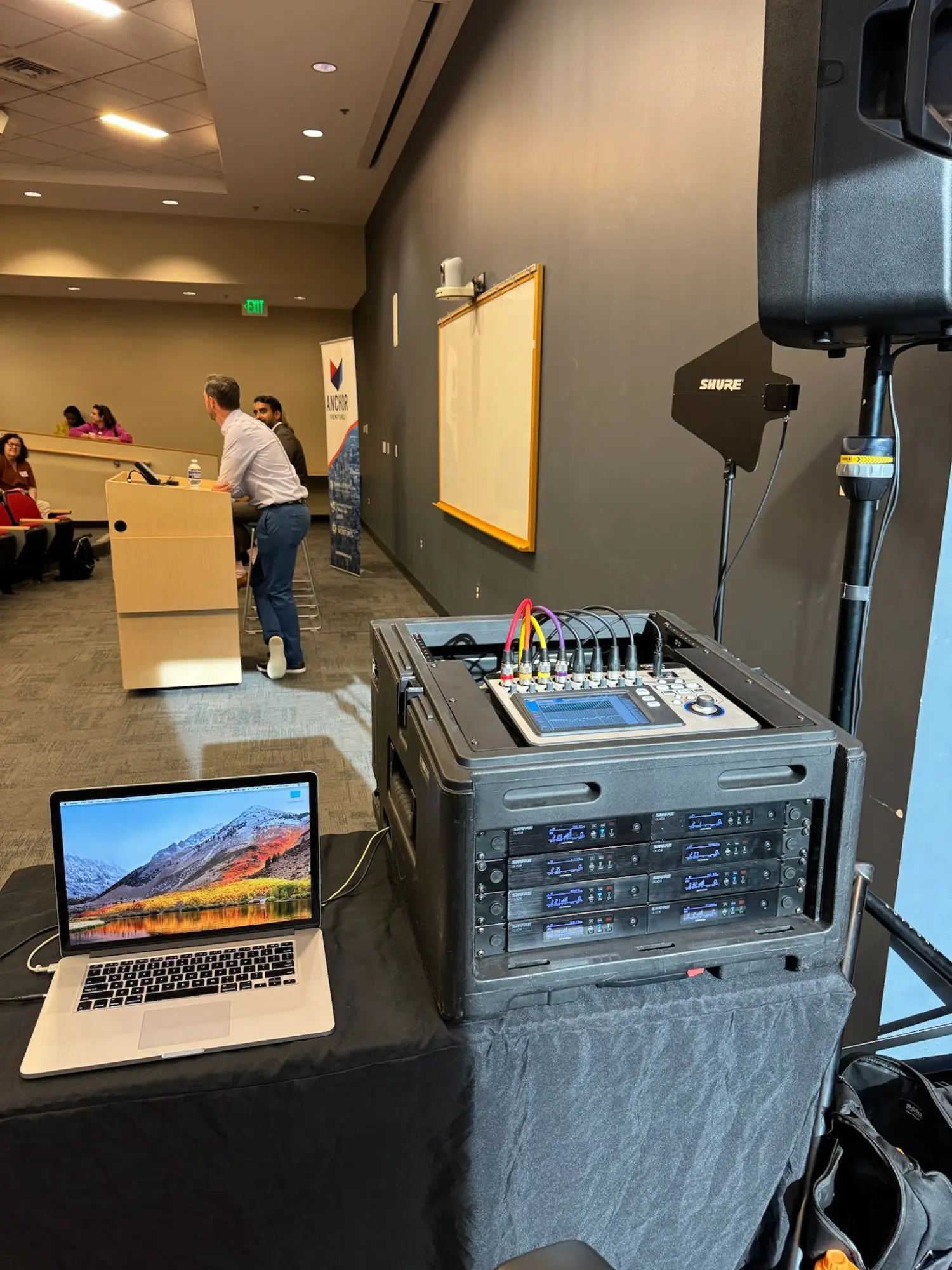
Programs run on professional digital consoles that we mix the room on before your doors open, not on whatever was left in the warehouse. Show files are built during the advance and saved, so a console swap mid-crisis is a file load, not a rebuild.
-
Wireless coordination
Any show with more than a handful of wireless channels gets an RF scan in the actual venue during setup. Frequencies are coordinated against the local environment and each other, logged, and given identified spares. Wireless failures at events are almost always coordination failures, so coordination is a step in our process, not an assumption.
-
Signal redundancy
Anything the program cannot repeat gets a second path: backup playback for videos and reveals, spare microphones staged at the platform, and protected routes for critical feeds. The redundancy is specced per show against the moments that matter; an internal meeting and an investor call carry different tiers, and we price both honestly.
-
Backup policy
Backups ride the truck as line-item equals, not afterthoughts: spare wireless, spare cabling, a redundant playback source, and critical spares for whatever the show most depends on. The plan for a failure is written before the show, so the response is a rehearsed handoff instead of an improvisation.
-
Camera workflow
Camera systems run over modern IP-based video (NDI) and SDI, with PTZ cameras for clean, quiet coverage and manned positions where a shooter’s judgment matters. Camera feeds, screens, and streams are engineered as one signal chain, so what the room sees, what the recording gets, and what the remote audience watches all stay consistent.
-
Press feeds and mults
For press-facing events we run a mult box: the distribution unit that gives every journalist and broadcast crew clean program audio direct from the console, without a pile of recorders taped to the podium. Video feeds for broadcast trucks are arranged during the advance. If media matters at your event, say so early and it becomes part of the design.
-
Power planning
Load calculations happen before every show, not at the wall outlet. We total the system’s real draw, map it against the venue’s available circuits during the advance, and separate audio from lighting power where the design calls for it. Tripped breakers mid-program are a planning failure, so we plan.
-
Insurance and paperwork
Certificates of insurance are available on request, issued to your venue’s requirements. Technical riders, floor plans, and cue sheets are written documents your venue and your team can review before load-in. If a commitment matters, it exists on paper.
Why publish this?
Most AV problems are invisible in the proposal
They're expensive on show day. A buyer who knows to ask about RF coordination, load calcs, and backup playback gets a better event from any vendor, including us. If your current AV provider can't answer these in writing, that's worth knowing before you sign, not after the microphone drops.
For how these standards show up in each department, see event audio, video & LED, and hybrid & streaming.
Standby
Hold us to all of it.
Bring your hardest technical questions to the first call. The answers are the product.