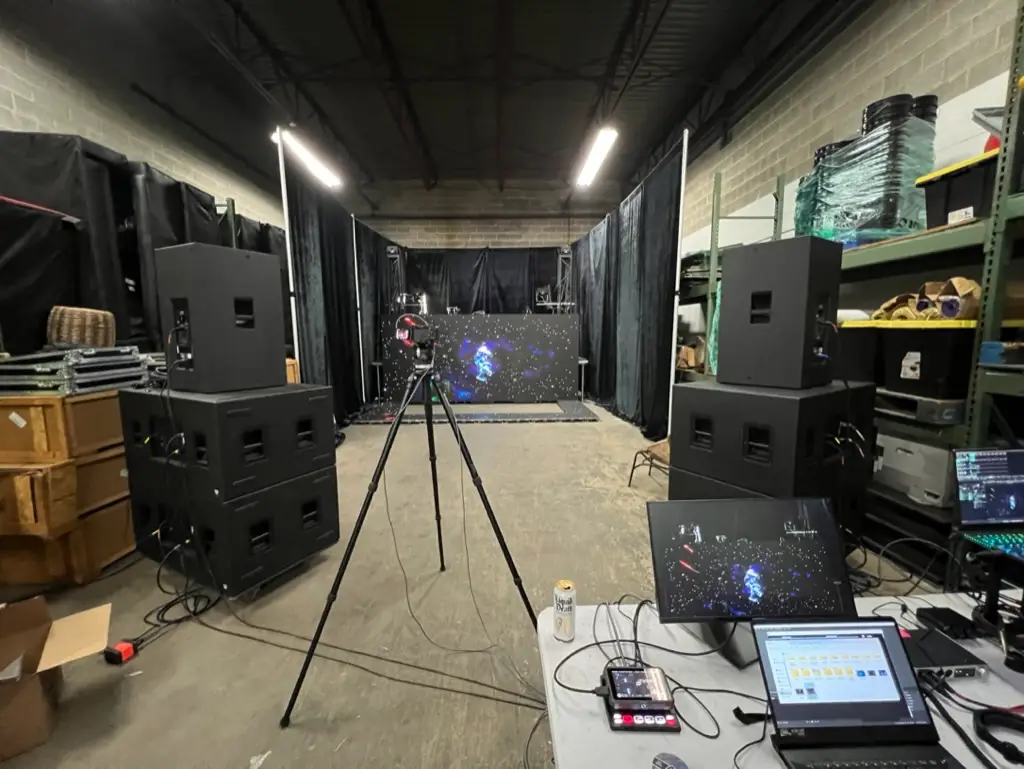
The number that matters in an LED wall rental in Baltimore isn’t the panel count. It’s whether the wall is designed for your content, your sightlines, and your room’s power, and whether the person driving it has done it before. Every video system we send arrives with the engineers who build it, drive it during the program, and strike it after. The wall is the product; the crew is the guarantee.
What this covers
- LED video walls — modular walls built to the size and shape your stage design calls for, ground-supported or flown, color-balanced to camera when there’s IMAG or a stream in the plan.
- Projection — screens and projectors specced to your room’s throw distances and ambient light, including blended widescreen formats for general sessions.
- IMAG (image magnification) — live camera shots of your speakers on the big screen, so a 600-person room feels like a 60-person room.
- PTZ and manned camera systems — remote-controlled cameras for clean, quiet coverage, mixed by an operator; manned cameras where the program calls for a shooter’s judgment.
- Screen switching and playback — slides, videos, live cameras, and speaker timers routed through a switcher with an operator following your run of show.
What’s always included
Every video production includes a site-informed design (we confirm dimensions, power, and rigging with the venue before quoting), an operator behind every live screen, redundant playback for anything mission-critical, and a strike plan the venue signs off on. If your event has a stream or recording attached, the screens and cameras are engineered as one signal chain.
How we spec it
Pixel math before panel count. A wall that’s beautiful from the back row can be a screen-door up close. We start from your nearest seat and your content (fine text and spreadsheets need tighter pixel pitch than full-screen video) and spec the wall from there.
Ambient light decides LED vs. projection. Ballroom programs increasingly run with house lights up — for note-taking, for cameras, for energy. Projection washes out under those conditions; LED doesn’t care. But in a controlled-light general session, projection can deliver a bigger image for less. We price the crossover instead of defaulting to the more expensive answer.
Camera counts follow the program. A single well-placed PTZ covers a podium program. A panel needs two angles minimum so the screen isn’t stuck on a wide shot. Award shows need a walk-up camera. We build the camera plan from your run of show — it’s the cheapest place to over-plan and the most painful place to under-plan.
The full signal-chain approach (switching, redundancy, and how we handle press feeds) lives on our standards page.